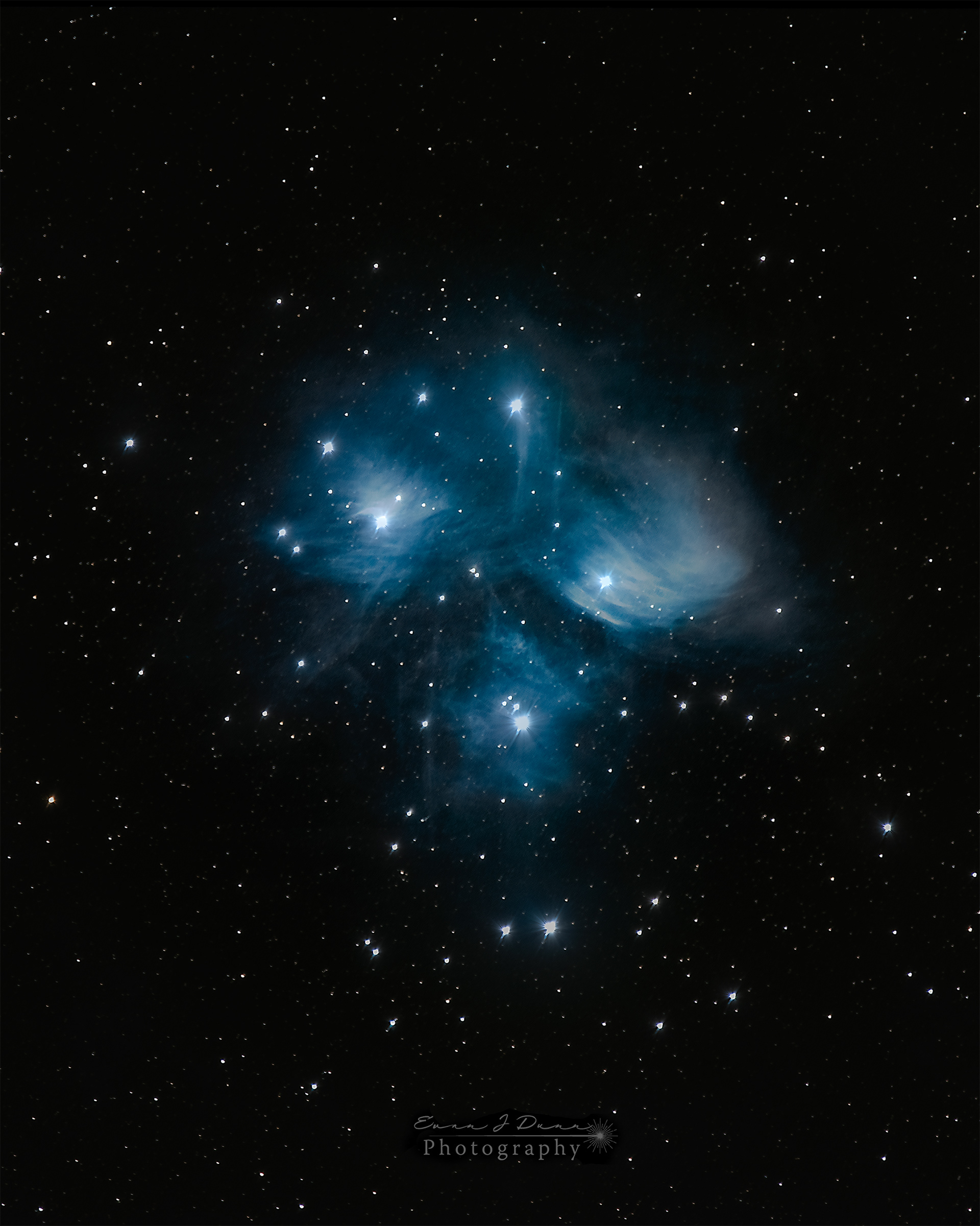
The Pleiades, Seven Sisters, or Messier 45, is likely the most famous star cluster in our sky.
As one of the largest and brightest deep sky objects, it was a perfect target to get back into form with; after briefly escaping the purgatory of full-time employment.
The Pleiades, while it appears static, is actually passing through a cloud of interstellar dust, which it is *not* responsible for creating. Unlike other Nebulae that I’ve shared previously which emit their light from photons coming form nearby stars colliding with and energizing regions of interstellar gasses, the bright blue nebula that surrounds these stars is simply starlight being scattered and reflected by this otherwise dark, cold cloud of space dust. Making the Pleiades cluster a Reflection Nebula! It's a chance encounter, and we get a 444-light-years-away front-row seat.
This cluster is incredibly young, by space standards. At just around 100 million years old, these stars were forming while dinosaurs roamed the Earth.
While this is a deep-sky object, the star cluster itself is incredibly bright. The challenge is always pulling out the faint, wispy nebulosity without completely blowing out the intensely bright stars. Unsurprisingly this is one of my favourite winter targets!
As one of the largest and brightest deep sky objects, it was a perfect target to get back into form with; after briefly escaping the purgatory of full-time employment.
The Pleiades, while it appears static, is actually passing through a cloud of interstellar dust, which it is *not* responsible for creating. Unlike other Nebulae that I’ve shared previously which emit their light from photons coming form nearby stars colliding with and energizing regions of interstellar gasses, the bright blue nebula that surrounds these stars is simply starlight being scattered and reflected by this otherwise dark, cold cloud of space dust. Making the Pleiades cluster a Reflection Nebula! It's a chance encounter, and we get a 444-light-years-away front-row seat.
This cluster is incredibly young, by space standards. At just around 100 million years old, these stars were forming while dinosaurs roamed the Earth.
While this is a deep-sky object, the star cluster itself is incredibly bright. The challenge is always pulling out the faint, wispy nebulosity without completely blowing out the intensely bright stars. Unsurprisingly this is one of my favourite winter targets!